

Many business owners use the terms “logo design” and “brand identity” interchangeably. While they are closely related, they are not the same thing.
A logo is an important part of a brand, but it represents only one piece of a much larger puzzle. Businesses that understand the difference between logo design and brand identity are better positioned to create stronger brands, build customer trust, and stand out in competitive markets.
If you’re building a business, understanding this distinction can help you make smarter branding decisions and create a more memorable customer experience.
What is a Logo?
A logo is a visual symbol that represents a business.
It is often the first thing people recognize about a company and serves as a quick identifier for customers.
A logo can include:
- A symbol or icon
- A wordmark
- Initials or monograms
- A combination of text and graphics
Some of the world’s most recognizable companies are instantly identified by their logos because they have consistently used them over time.
However, a logo alone does not define a brand.
What is Brand Identity?
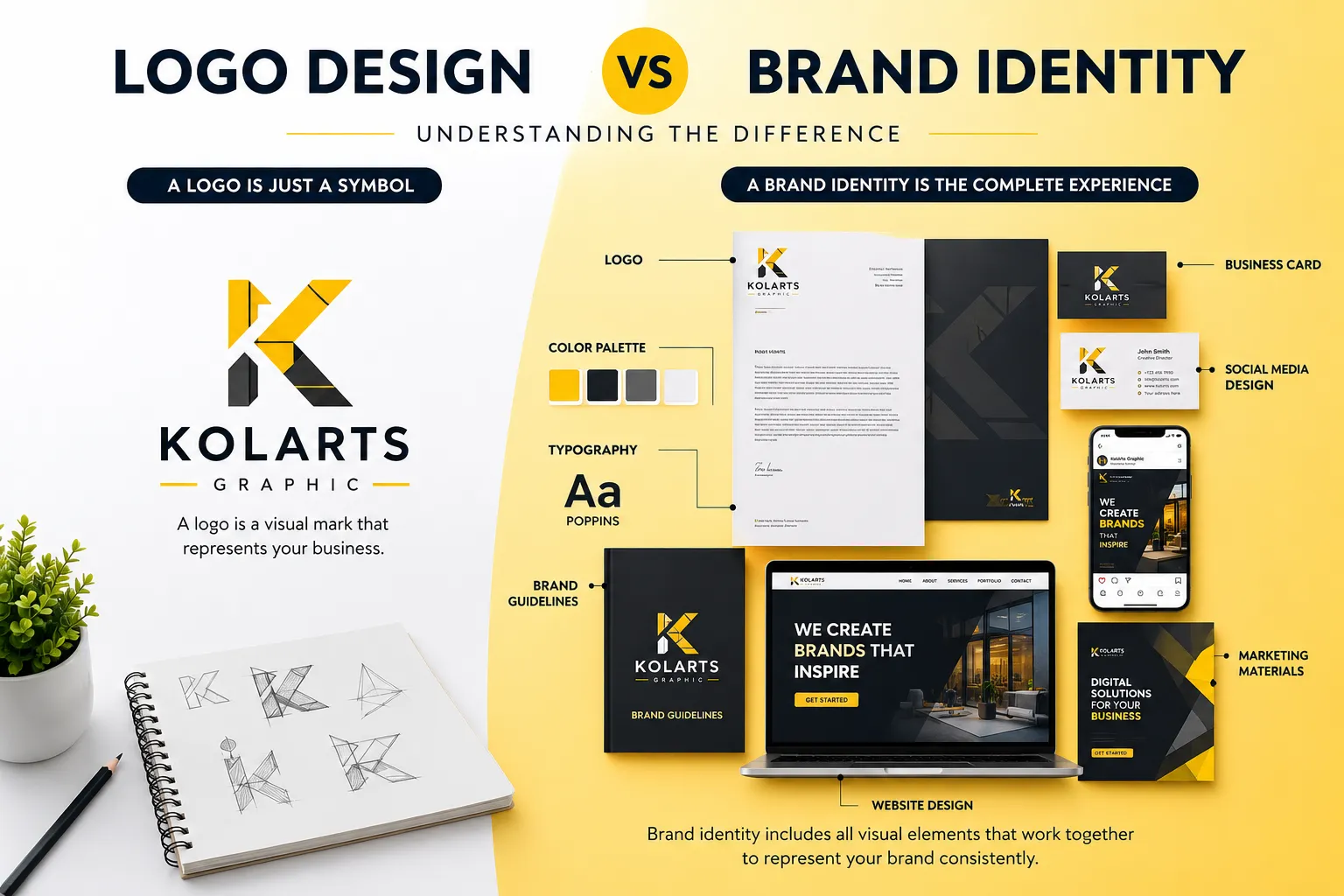
Brand identity is the complete visual system that represents a business.
It includes every visual element customers interact with and helps communicate the personality, values, and message of a brand.
A brand identity typically includes:
- Logo design
- Color palette
- Typography
- Brand guidelines
- Business cards
- Social media graphics
- Website design
- Marketing materials
- Packaging design
- Visual style and imagery
Together, these elements create a consistent experience that customers recognize and trust.
The Difference Between Logo Design and Brand Identity
A simple way to understand the difference is:
A logo is a single element. Brand identity is the complete visual ecosystem.
Think of it this way:
A logo is like a person’s face.
Brand identity is their personality, voice, style, behavior, and overall presence.
People may recognize a face, but they remember the complete experience.
The same principle applies to businesses.
Why a Logo Alone Isn’t Enough
Many businesses invest in a logo and assume their branding is complete.
Unfortunately, this often creates inconsistency.
Without a defined brand identity:
- Marketing materials look disconnected
- Social media lacks consistency
- Brand recognition becomes weaker
- Customers struggle to remember the business
- Professionalism can suffer
A logo can identify a business, but a strong brand identity helps customers remember and trust it.
How Brand Identity Builds Recognition
Consistency is one of the most powerful tools in branding.
When customers repeatedly see the same:
- Colors
- Typography
- Design style
- Visual elements
- Messaging
They begin to associate those elements with your business.
Over time, this creates stronger brand recognition and customer loyalty.
The most successful brands in the world maintain consistent visual identities across every platform and customer touchpoint.
Key Elements of a Strong Brand Identity
Color Palette
Colors influence emotions and perceptions.
The right color palette helps communicate the personality of your brand while creating visual consistency.
Typography
Fonts play a major role in how customers perceive a business.
Modern, clean typography can communicate professionalism, while creative typography can convey personality and uniqueness.
Visual Style
Photography, illustrations, icons, and graphic elements should follow a consistent style.
This helps create a recognizable brand presence.
Brand Guidelines
Brand guidelines document how visual elements should be used.
They ensure consistency across websites, social media, advertisements, and printed materials.
Benefits of Investing in Brand Identity
A strong brand identity can help businesses:
- Increase brand recognition
- Build customer trust
- Create a professional image
- Differentiate from competitors
- Improve marketing effectiveness
- Strengthen customer loyalty
Businesses with consistent branding are often perceived as more reliable and established.
Common Branding Mistakes
Many businesses weaken their branding by:
- Using inconsistent colors
- Frequently changing logos
- Using multiple font styles
- Creating inconsistent social media graphics
- Lacking brand guidelines
These inconsistencies can confuse customers and reduce brand recognition.
When Should a Business Invest in Brand Identity?
The best time to develop a brand identity is at the beginning of your business journey.
However, it’s never too late to improve your branding.
If your business has:
- An outdated logo
- Inconsistent marketing materials
- Weak brand recognition
- A changing target audience
It may be time to invest in a professional brand identity system.
Conclusion
A logo and a brand identity are both important, but they serve different purposes.
A logo helps customers identify your business, while a brand identity shapes how they perceive and remember it.
Businesses that invest in a complete brand identity create stronger connections with customers, improve recognition, and build long-term trust.
If you want your business to stand out in a crowded marketplace, focus on building more than just a logo. Build a brand identity that communicates who you are, what you stand for, and why customers should choose you.
Author: KolArts Graphic
Category: Graphic Design
Tags: Logo Design, Brand Identity, Branding, Graphic Design, Business Branding, Visual Identity, Brand Recognition, Logo vs Brand Identity